
 By Automotto
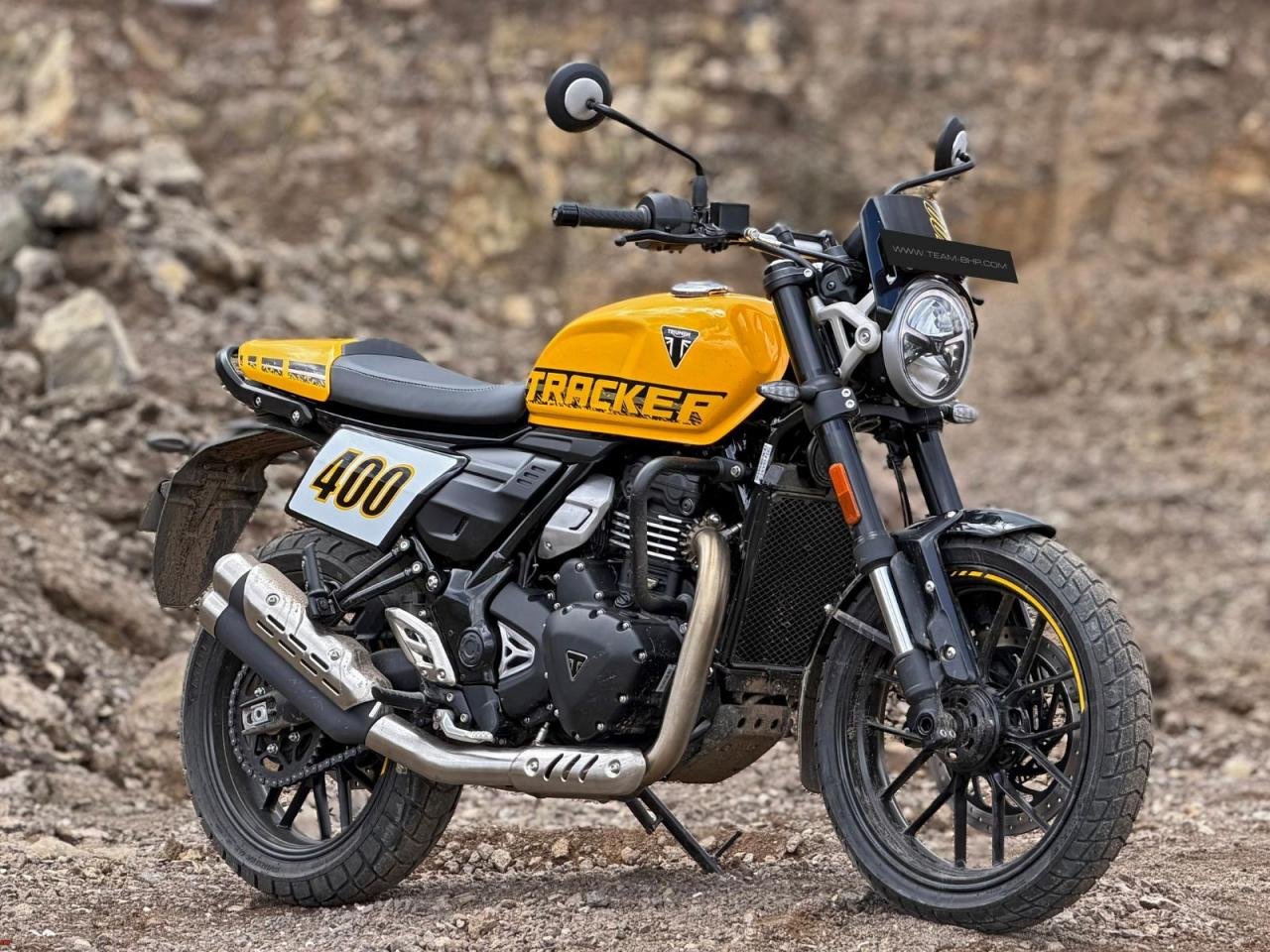
The Triumph Tracker 400 performance story starts with a small confession: the bike isn’t really a 400 anymore. Triumph’s India-built engines were downsized to 349cc, yet the “400” name stuck on the tank. So is the smaller motor a step backwards, or does the Tracker still feel like the quick, playful flat-tracker its styling promises? Autocar India put the bike through instrumented testing, and the numbers tell a more interesting story than the spec sheet does.
First, What Is Actually Under the Tank?
The Tracker runs a 349cc, liquid-cooled single-cylinder engine paired to a 6-speed gearbox. Triumph got to the smaller size by shortening the stroke of the old 398cc unit and leaving the bore alone.
On the Tracker, the motor is in the same higher state of tune as the Thruxton 400: 40hp at 8,750rpm and 32Nm at 7,500rpm. The Speed 400 and Scrambler 400 X make 37hp, so the Tracker has a small edge on paper. That tune is a big part of the Triumph Tracker 400 performance story, since it matches the Thruxton 400.
Other basics worth knowing: it weighs 181kg, the seat height is 805mm, and the tank holds 13 litres. Brakes are a 300mm disc up front and a 230mm disc at the rear, and the tyres are 110/70 and 150/60 section 17-inchers.
Triumph Tracker 400 Performance: Acceleration Numbers
Here’s what the instrumented run showed, according to Autocar India’s test, done in dry conditions:
| Run | Time |
|---|---|
| 0-60kph | 3.05s |
| 0-80kph | 4.86s |
| 0-100kph | 7.55s |
That 7.55 seconds to 100kph is a useful reality check. An earlier ride review of the bike expected low-six-second times, and the stopwatch says otherwise. It’s still brisk for a 349cc single, just not as sharp as first impressions suggested.
The reason is how the engine delivers its power. It’s now more linear than the old 398cc motor, which had a stronger low and mid-range. However, the real meat arrives after 6,000rpm and keeps pulling cleanly to the redline. In plain terms, this is an engine that rewards you for revving it.
Roll-On Acceleration: Triumph Tracker 400 Performance in Traffic
Roll-ons matter more than 0-100 times in daily riding, because they show how the bike responds when you’re already moving and want to overtake. This is where Triumph Tracker 400 performance feels different from the older 398cc bike.
| Roll-on | Time |
|---|---|
| 20-50kph (2nd gear) | 2.44s |
| 30-70kph (3rd gear) | 4.15s |
| 50-80kph (4th gear) | 4.32s |
These are decent but not dramatic. Autocar’s takeaway was that the bike can hit highway speeds without strain and has enough in reserve for quick overtakes, though a downshift or two makes them faster.
The catch is that the smaller engine has lost some of the effortless shove the 398cc versions had. In practice, you get the performance, but you have to work for it.
For context, the same publication measured the 37hp Scrambler 400 X at 2.82s, 4.12s and 4.20s in the same three roll-ons. Different bikes and gearing, so treat it loosely. Still, it shows the Tracker’s extra power is a top-end story, not a mid-range one.
Triumph Tracker 400 Performance: Braking Confidence
Braking is the other half of Triumph Tracker 400 performance, and it’s a strong half. The Tracker stopped from 60kph in 16.75 metres, which Autocar described as good stopping power with good feedback.
Two things help here. Like most of the 350cc Triumphs (the Scrambler is the exception), it uses sintered brake pads, which hold up well under repeated hard stops. On top of that, at 181kg, it simply has less mass to slow down.
On the safety side, expect dual-channel ABS that can’t be switched off, a slip-assist clutch, and switchable traction control. There are no riding modes, no Bluetooth connectivity, and no immobiliser, so the equipment list is deliberately basic.
How It Behaves at Cruising Speed
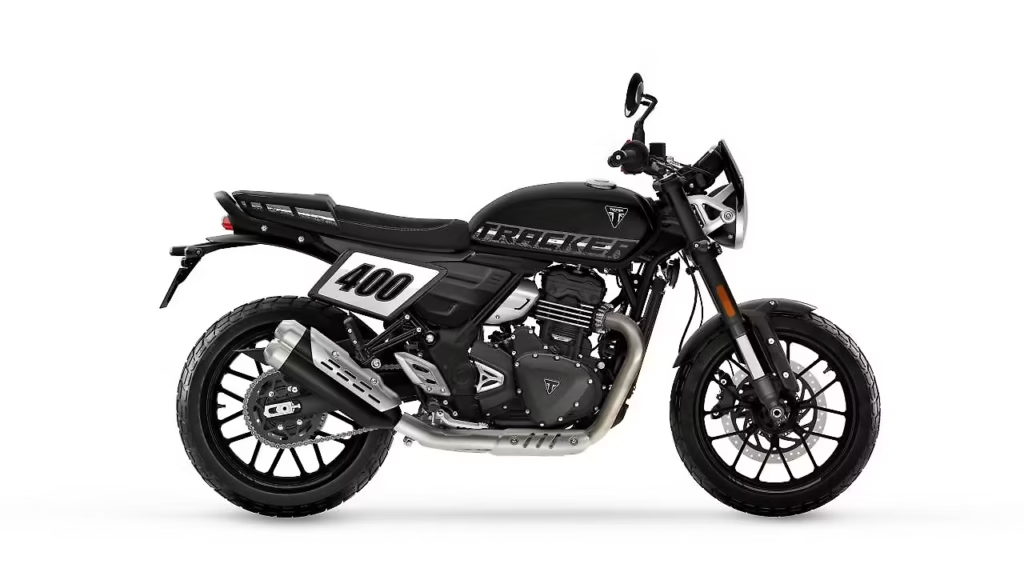
At cruising speed, Triumph Tracker 400 performance stays smooth up to roughly 110kph. The gearing is well spread, and cruising in 6th gear at 90-100kph is where the engine sits comfortably. Holding 100kph is easy, with the buzz only building above roughly 110kph.
Vibration does creep in above 8,000rpm, so this is not a bike to keep pinned near the redline for long stretches. Despite the chunky, dual-purpose tyres, reviewers found the handling capable and entertaining, with plenty of lean-angle clearance so you won’t scrape the pegs easily.
Mileage and Range
Good mileage is a quiet bonus in the Triumph Tracker 400 performance package. In Autocar India’s separate mileage test, it returned 24.1kpl in the city and 31.7kpl on the highway, for an average of 27.9kpl. With a 13-litre tank, that works out to a real-world range of around 360km between fill-ups.
Price and Who It Rivals
The Tracker launched at ₹2.46 lakh (ex-showroom, Delhi), and Autocar’s test page lists ₹2.42 lakh. Some listings show higher figures after price changes, so confirm the current number with your dealer. It comes in three colours: Aluminum Silver, Racing Yellow and Phantom Black.
Rivals include the Royal Enfield Guerrilla 450 and the Harley-Davidson X440 T, and buyers who want raw speed may also look at the KTM 390 Duke. If you’re comparing sporty small-displacement options, our Yamaha R2 showroom arrival piece covers a very different kind of fast.
The Verdict on Triumph Tracker 400 Performance
Overall, Triumph Tracker 400 performance is quick enough to be fun without being intimidating. The bike isn’t a drag-strip weapon, and the flat-track styling is more attitude than heritage.
What it does well is blend a peppy top end, confident brakes, good mileage and a premium feel into a bike that’s fun in the city. Just remember the riding position is more committed than a typical roadster, and you’ll need to rev it to get the best from it.
FAQs
Is the Triumph Tracker 400 really a 400cc bike? No. It uses a 349cc engine, downsized from the older 398cc unit, though the “400” name was kept.
How fast is the Triumph Tracker 400? In Autocar India’s instrumented test, it did 0-60kph in 3.05s, 0-80kph in 4.86s and 0-100kph in 7.55s.
How good are the Triumph Tracker 400’s brakes? It stopped from 60kph in 16.75 metres, helped by sintered pads and a kerb weight of 181kg.
What mileage does the Triumph Tracker 400 give? Autocar India measured 24.1kpl in the city, 31.7kpl on the highway and 27.9kpl overall, for a range of about 360km.